


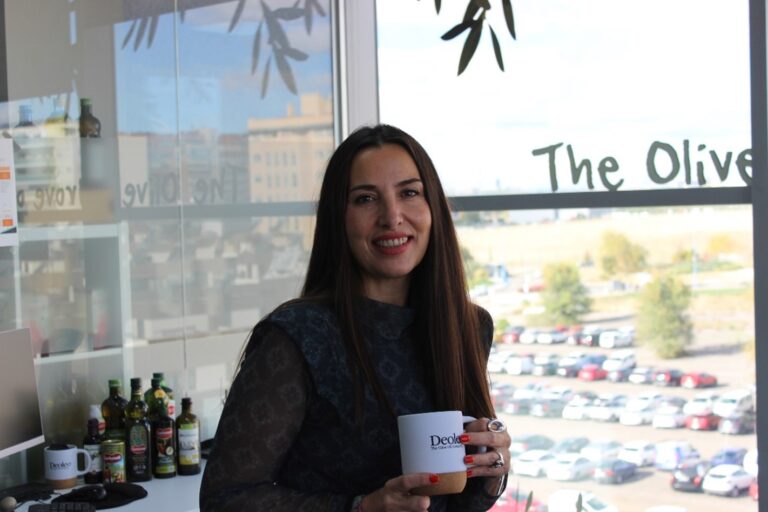
A coffee with Nieves Ocaña, Head of Global Purchasing at DEOLEO
Empack: Tell us a bit about your experience at Deoleo and what your day-to-day work within the company is like.
Nieves: I have been part of Deoleo for more than two decades. From day one, I have felt proud to work for a company that is part of our Mediterranean culture thanks to its flagship product: olive oil. We work with leading global brands such as Carbonell, Bertolli and Carapelli, and that leadership is reflected in the figures. In 2024, the company reached a turnover of nearly €996 million, which highlights the scale and impact of our daily work.
My career has always been linked to the Purchasing and Supply area, where we coordinate everything from supplier sourcing and selection to category strategy, critical negotiations, contracting, and just-in-time supply of materials to our plants. Day-to-day work is very dynamic, combining long-term strategic vision — essential to mitigate global risks — with immediate operational management. The key lies in anticipation and agility: analysing real-time data, understanding global market trends, and making swift decisions to ensure the supply of materials with the quality and timing required by both our customers and production.
I am part of a highly talented and experienced team, which makes the work flow naturally and efficiently. In addition, we contribute directly to sustainability goals and to driving innovation in new packaging formats.
Empack: After more than 20 years of experience in the company, which projects have been the most challenging, or which ones do you remember most and why?
Nieves: Throughout my career I have faced many challenges, but the most significant ones have undoubtedly been the integrations resulting from the acquisition of other companies. Aligning methodologies, processes and, above all, very different working cultures under one umbrella is not easy. However, the effort invested has allowed us to grow, learn from best practices and generate very positive operational and cultural synergies across the entire global corporation.
Another project I remember with particular satisfaction — and one that truly transformed our area — was the full digitalisation of Purchasing through the implementation of an advanced electronic negotiation platform. This change was a major turning point, forcing us to review the entire process from start to finish, but the outcome was a much more transparent, agile and effective system. It enabled us to standardise process reuse, define a common working methodology across different countries, and provided the visibility we needed for more informed decision-making.
In terms of innovation, in 2025 we launched our “CHEF” project (what others call an “oil dispenser”), which is completely new in terms of packaging: a new bottle, a new cap, and a radically different concept in both image and user experience for the consumer. This strategic rollout was successfully implemented under our main brands in key markets such as Spain, Italy and the United States.
Empack: What is Deoleo’s commitment to sustainability? What changes have you implemented and what changes do you expect to implement in the near future?
Nieves: At Deoleo, we are firmly committed to sustainability, which is one of the fundamental pillars of our strategy and an essential part of our social and environmental responsibility. We work to reduce our environmental impact through initiatives that span the entire value chain. This commitment is quantifiable. For example, in just two years we have managed to reduce our greenhouse gas emissions (scope 1 and 2) by 30%. In addition, we have been awarded the EcoVadis Platinum medal, which places us among the top 1% of companies worldwide in terms of ESG ratings.
We have installed solar panels at our plants to produce clean energy, and currently 98% of the energy we use comes from certified renewable sources, allowing us to move towards self-consumption. We have implemented a ‘zero waste’ strategy, ensuring that 94% of the waste generated is reusable. In terms of materials, we have replaced vPET with recycled rPET in our bottles (already present in 25% of our packaging) and replaced virgin paper with recycled paper in our packaging. In addition, we prioritise collaboration with nearby suppliers to minimise transport emissions.
Empack: What do you think are the biggest advantages of trade fairs such as Empack and Logistics & Automation for our industrial fabric?
Nieves: Trade fairs such as Empack and Logistics & Automation are a unique and multifaceted opportunity for our entire industrial fabric. Firstly, they act as an essential window to innovation, allowing us to connect with other professionals in the sector, discover new trends in materials and processes, and learn first-hand about the latest technologies that are breaking into the market.
For an area such as Purchasing, it is essential to be able to visit suppliers face-to-face, establish high-value strategic contacts and gather ideas that we can immediately integrate into our own efficiency or sustainability projects. Furthermore, these events represent a space for constant inspiration and learning. Talks, success stories from other industries, and presentations on leadership or digital transformation help us disconnect from the usual pace of daily work and open our minds to new ways of doing things. Participating in industry meetings such as these revitalises our way of thinking and drives us to innovate beyond the everyday.
Share this article


Stay informed

Did you know… the iconic heart-shaped chocolate box was born in the 19th century?
A staple of Valentine’s Day around the world. Have you ever wondered where the tradition of giving chocolate in a heart-shaped box originated? Chocolate has
AIMPLAS strengthens its research lines in 2025 to promote sustainability in the plastics sector
The plastics sector is moving towards a more sustainable, competitive model that is aligned with European regulations thanks to the drive for R&D&I. In this
The EU is changing the rules and in 2026 will require bars and restaurants to eliminate ketchup, sugar and oil sachets.
No more individual sachets of sauces, sugar or salt in Spanish bars and restaurants. The European Union has already set a date for the definitive
A coffee with Nieves Ocaña, Head of Global Purchasing at DEOLEO
Empack: Tell us a bit about your experience at Deoleo and what your day-to-day work within the company is like. Nieves: I have been part

