


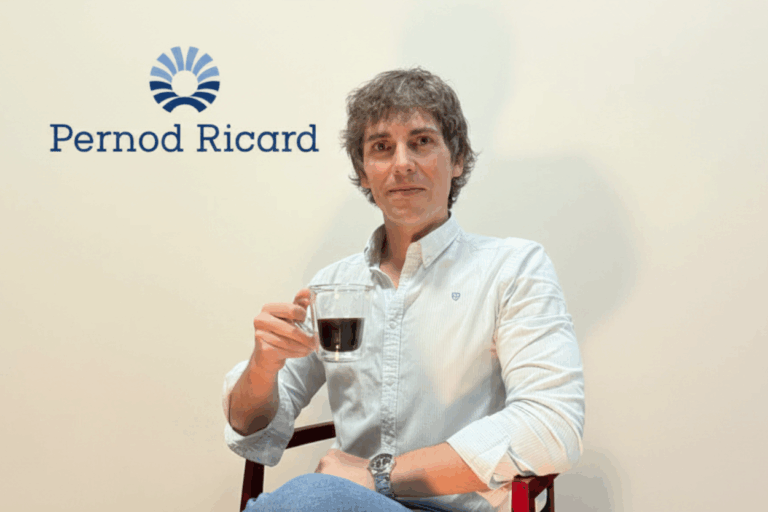
A coffee with José Manuel Muñoz, BOTTLING MANAGER en Pernod-Ricard.
José Manuel, Agricultural Engineer (UPM) and Food Technologist (UAM) with more than twenty-five years of experience, has led production, logistics and continuous improvement areas in major companies such as Bimbo, Schweppes and García Carrión. Currently, as Production Manager at Pernod Ricard, he applies his strategic and technical vision to optimise processes and teams, ensuring maximum efficiency under the most demanding quality and safety standards in the industry.
Empack: José Manuel, tell us a bit about your experience at Pernod Ricard and what your day-to-day work looks like within the company.
Although I have been at Pernod Ricard for less than two years, this professional period has been intense and productive, with a constant pursuit of operational excellence. My day usually starts by analysing the performance of the bottling lines (OEE) and the main issues that occurred the previous day. These are then reviewed in the first morning meeting together with the rest of the departments involved in production.
From that point on, line planning becomes a daily puzzle, where work shifts must be organised and changeover times minimised in order to fulfil 100% of the planned orders and meet supply chain demand.
This operational activity is complemented by a busy schedule of coordination meetings and participation in cross-functional projects, combined with managing my own projects and supervising the bottling lines in real time. I frequently collaborate with departments such as quality, maintenance and industrial administration to improve traceability or reduce costs. Rigour is non-negotiable, especially in terms of quality control, waste management and excise duties.
Finally, my role involves strong team leadership with an absolute commitment to safety and hygiene for both people (H&S) and processes (QSE), ensuring that every batch meets the company’s demanding quality standards. In this way, we make sure that each working day is not only productive but also safe for everyone involved.
Empack: After such a long professional career in different companies, which projects have been the most challenging for you or which ones do you remember most clearly, and why?
First of all, I would highlight my experience in logistics, as it represented a major challenge given my lack of prior knowledge and experience in that field. When I joined the department, we identified key opportunities to harmonise operations and strengthen the strategic connection between production and logistics. Despite the strong seasonality and variability in workload, we focused on bringing structure and fluidity to daily processes.
To achieve this, it was essential to rely on the talent of the team—professionals with a great work capacity with whom we promoted a more dynamic and versatile model. This collaboration allowed us to optimise warehouse management and improve route planning. Ultimately, this stage was an exercise in aligning criteria, where we managed to transform complex scenarios into efficient and coordinated management, demonstrating that adaptability and leadership are essential to overcoming operational challenges and enhancing results.
Secondly, I would highlight my current professional project. Moving from producing and distributing private-label products to working with our own brands has been a significant change and has required a major adaptation effort on my part. Pernod Ricard’s philosophy is defined by the concept of “Convivialité”, transforming the sale of spirits into a celebration of human relationships and shared experiences.
Empack: What do you think are the main advantages of having trade fairs like Empack for the food & beverage industry and for the visibility of research in this sector?
Having trade fairs such as Empack represents a key strategic driver for the food and beverage industry, a sector where packaging has evolved from being a simple container to becoming a guarantee of safety and competitiveness.
In this sense, the event makes it possible to discover first-hand advances in active packaging and barrier technologies—innovations that are crucial for reducing particle migration and combating food waste, ensuring that products reach the end consumer in optimal freshness conditions.
The exhibition also becomes an essential resource for navigating the current complex regulatory landscape. With ongoing regulations on plastics and circular economy requirements, the event offers tangible solutions in eco-design and compostable materials, enabling companies to comply with legislation without compromising operational efficiency.
In this way, Empack acts as a “living showcase” for research, development and innovation, facilitating the technological transfer needed for advances in new polymers or smart labelling to move directly from the laboratory to industrial implementation.
Finally, these types of spaces help validate the trends shaping the future of the market. Through areas dedicated to design and functionality, it becomes clear how aesthetic research responds to new consumption habits, enhancing the perceived value of brands. In short, Empack bridges the gap between materials science and the global market, ensuring that innovation is not only visible but also profitable and sustainable for the entire business ecosystem.
Empack: Looking to the future, what would you like to see implemented in the sector within the next five or ten years in terms of sustainability or innovation?
Looking ahead to the 2030–2035 horizon, the packaging sector is expected to evolve from a simple “damage-reduction” strategy towards a model of complete regeneration and deep digitalisation.
If we dare to imagine it, this transformation would aim to turn packaging into an active ally of planetary health, starting with the standardisation of so-called “living packaging.” The goal is that third-generation materials, grown from fungal mycelium or algae, would not only be compostable but would disappear within days without leaving microplastics, even allowing consumers to ingest them or use them directly as fertiliser.
Alongside this biotechnology revolution, the future of the sector will rely on total traceability supported by the digital product passport. In this scenario, every package would have a unique identity allowing anyone to know the real carbon footprint of a product through a simple scan. This transparency would also enable waste management systems to automatically identify each item, ensuring perfect molecular recycling and eliminating uncertainty in the materials recovery chain.
Finally, this vision is completed with an automated logistics system that leaves behind the traditional “use-and-discard” model. Tomorrow’s ecosystem will integrate intelligent reverse-logistics systems where drones or autonomous vehicles collect highly durable and standardised packaging directly from homes. Once sanitised and returned to the production cycle, the reuse loop will be closed, eliminating the need to produce virgin materials and consolidating the integration of artificial intelligence and biotechnology as the new standard for the industry.
Empack: Finally, if you could give advice to your younger self from ten years ago, considering the unpredictable changes we have faced in recent years, what would it be?
If I could speak to my younger self from a decade ago, the headline would be:
“Don’t prepare for the plan—prepare for change.”
Ten years ago, the world underestimated the speed of digital transformation and the urgency of the climate crisis. My advice would be to prioritise mental and operational agility over rigid stability. In a sector like packaging, I would tell myself to stop seeing packaging as an inevitable waste and start seeing it as an asset of data and biotechnology.
I would warn that global crises—from pandemics to supply-chain disruptions—are not anomalies but catalysts. Therefore, the real competitive advantage is not having the fastest machine, but the ability to pivot: moving from plastic to biopolymers in months, or from physical retail to e-commerce in weeks.
Finally, I would say that radical collaboration will be the most valuable currency. No one survives unpredictable change alone; future success depends on creating ecosystems where science, industry and social awareness converge.
In short: invest in resilience, embrace uncertainty and never underestimate the power of a good sustainable idea.
Share this article


Stay informed

Pack Talks: Sustainability as a Driver of Innovation: From Trend to Commodity
Sustainability in the packaging sector has evolved from an emerging trend into a key driver of innovation. However, this transition is not as straightforward as
Roland DG expands compatibility of D-EA2 multicolour inks with the TrueVIS XP-640
Roland DG Corporation announces the expanded availability of its cost-effective D-EA2 multicolour eco-solvent inks, now compatible with the TrueVIS XP-640. This upgrade makes Roland DG’s
Mondi reveals how corrugated cardboard packaging can reduce food waste
Mondi has published a new technical report exploring how the right packaging can help food producers and retailers protect product quality and reduce waste in
A coffee with… Ferran Vaqué, Private Label Business Director at PROQUIMIA
Ferran Vaqué Bover is Director of White Label Business for the Domestic Division of Proquimia, a chemical company specialising in hygiene and cleaning solutions. He
