


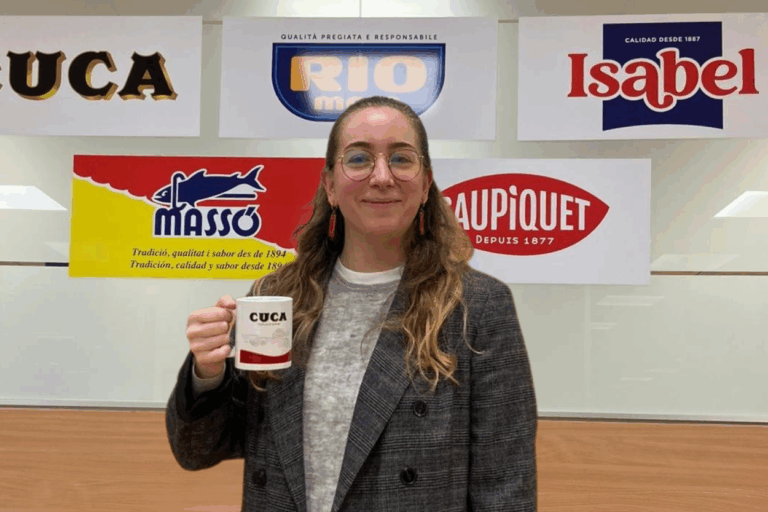
A coffee with Catalina Cortizo, Quality Packaging Supervisor at Bolton Food
Empack: Catalina, tell us a bit about your experience at Bolton Food and what your day-to-day work looks like within the company.
My experience at Bolton Food O Grove has been very enriching from day one. I joined a year ago as a Quality Packaging Supervisor and, since then, I’ve had the opportunity to be directly involved in key processes that ensure the quality of our products.
My daily work combines technical tasks, coordination with different departments across the company, and a significant analytical component. What I find particularly appealing about this role is the interaction with suppliers and the production team to validate materials and introduce improvements in packaging, and therefore in the overall process. In addition, as part of the packaging quality area, I also take part in the review and approval of new designs.
It’s a dynamic role where you learn something new every day, no two days are the same, which allows me to grow professionally.
Empack: After years of experience in this field, which projects have been the most challenging for you, or which ones do you particularly remember and why?
Although I haven’t been in the sector for that long, one of the most challenging aspects has been adapting to the modernization that factories have undergone in recent years. It has been a major transformation in many ways: processes, working methodologies, technologies, production speeds, and coordination between departments. From a Quality Packaging perspective, this has meant rethinking many procedures, understanding new production dynamics, and adapting to a constantly evolving environment.
This process has required continuous learning, both technical and operational. We’ve had to review materials, reformulate tests, and validate packaging under conditions that differ from those in the past, which has forced us to be more flexible and anticipate issues that didn’t previously exist. For me, one of the biggest challenges has been learning to work within this new context, understanding how every adjustment in the factory can affect packaging performance.
From a professional standpoint, this transformation has strengthened my adaptability and strategic thinking, and shown me the importance of continuous learning in such a fast-evolving sector.
Empack: What do you think are the main advantages of having trade shows like Empack for the food industry and for the visibility of research in this field?
Trade shows like Empack act as a meeting point between industry, innovation, and research—especially in such a demanding sector as food. One of their main advantages is the opportunity to discover new technologies, materials, and packaging solutions firsthand.
These events encourage exchange between professionals from different areas, creating a dialogue where trends, regulatory changes, and shared challenges across the industry are discussed. Personally, it has allowed me to discover suppliers and machinery that were not on my radar and are highly relevant to the industry I work in.
Empack: Could you name two key challenges currently faced by the food industry in terms of sustainable packaging and quality?
The first major challenge is moving towards more sustainable packaging without compromising food safety or product shelf life. Both at Bolton and in my previous experience in R&D, I’ve seen that replacing materials or reducing thickness requires extensive validation work to ensure properties remain optimal. The pressure to improve recyclability is significant, but it cannot come at the expense of product preservation.
The second challenge lies in the stability and consistency of sustainable materials. Many new alternatives still require optimization and adjustments to perform as reliably as traditional materials in industrial settings. This impacts machinery, thermal processes, storage, and logistics. Additionally, regulatory changes are constant, forcing companies to adapt quickly.
We also cannot overlook the major legislative changes we are experiencing, which go beyond the food sector. New regulations such as the EU “Green Claims” directive, as well as national legislation, are becoming increasingly demanding, requiring continuous updates in packaging design.
In my opinion, the industry must balance innovation, sustainability, and quality, a major challenge that requires significant research and investment.
Empack: Finally, if you could give advice to your younger self from 10 years ago, considering the unpredictable changes we’ve faced in recent years, what would it be?
If I could give advice to my younger self, I would definitely say: learn to be flexible and don’t be afraid of change. Over the years, I’ve realized that nothing stays the same for long—companies evolve, technologies advance, processes transform, and entire industries shift, requiring constant adaptation.
At first, this was something I found difficult to adjust to, but it’s essential in today’s professional world, where changes happen much faster than before.
Understanding this earlier would have helped me face some of these changes with less uncertainty and more confidence in my ability to adapt.
Share this article


Stay informed

A coffee with Juan Carlos Maroto, Co-founder and CMO, Curius AG
Empack: Juan Carlos, to start with, could you tell us a bit about your career and what your day-to-day life is like at the moment?
A coffee with Catalina Cortizo, Quality Packaging Supervisor at Bolton Food
Empack: Catalina, tell us a bit about your experience at Bolton Food and what your day-to-day work looks like within the company. My experience at
The beer that adds ‘with’ to ‘without’.
At Batllegroup, we have been working on branding and packaging for the consumer goods sector for over 30 years, in a context where design has
12 August 2026: The date that will shape the future of packaging in Europe
The packaging industry is facing a key milestone: 12 August 2026, the date on which the European Packaging and Packaging Waste Directive (PPWR) comes into
