


The beer that adds ‘with’ to ‘without’.
At Batllegroup, we have been working on branding and packaging for the consumer goods sector for over 30 years, in a context where design has moved beyond being merely an aesthetic consideration to become a strategic tool.
Our work involves helping brands understand the market in which they compete and position themselves clearly within it, making decisions that have a real impact on the business.
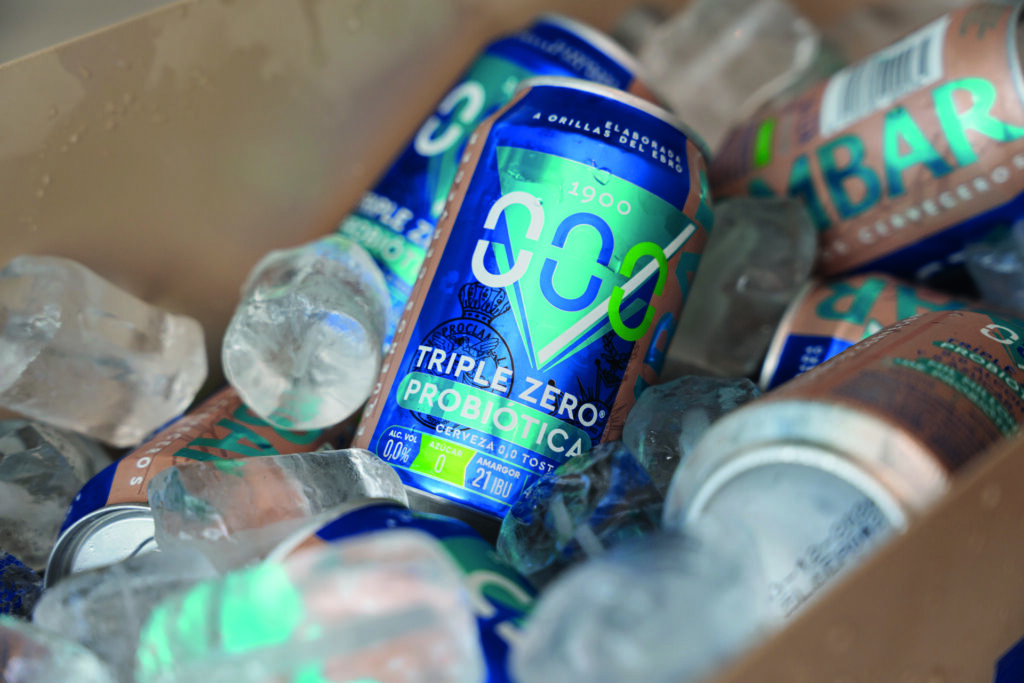
In recent months, we have been working on the new branding and product range for Cervezas Ambar, a project that will be rolled out progressively throughout this year.
A changing market
Beer has historically been one of the most stable categories in the consumer goods sector, but that stability is under pressure.
On the one hand, alcohol consumption is moderating, particularly amongst younger generations, where drinking less is no longer an imposition but a conscious choice. Globally, over 40 per cent of consumers say they are reducing their consumption.
On the other hand, beer no longer competes solely with other beers. It is entering a space where it coexists with functional drinks, sparkling waters and wellness products, which are growing at rates of 5% to 10% annually.
And here lies a key shift: wellness is no longer seen as a restriction, but as a balance. It is not about giving things up, but about being able to choose without feeling like you are missing out.
Against this backdrop, Spain has also become one of the world’s most advanced markets for non-alcoholic beer, which now accounts for approximately 14 per cent of total consumption. But what is truly significant is not the figure itself, but the shift in perception: non-alcoholic beer is no longer a compromise but a choice. People want alternatives that allow them to enjoy themselves without having to give anything up.
From subtraction to addition
In this context, the non-alcoholic category has grown on the basis of a clear logic: subtraction.
Subtract alcohol. Subtract sugar. Subtract calories.
It is a logic that makes sense and has been key to the growth of the non-alcoholic category (and many other categories), but it also has its limits. Because when the entire narrative is based on what you remove, the perceived value ends up being defensive. It is built on what is taken away.
What is interesting is that this is not an isolated trend, but the point at which the entire category begins to transform.
What is now beginning to emerge – and where we believe one of the most interesting opportunities lies – is the shift from this logic of subtraction to a logic of addition. Not just removing what is superfluous, but adding something of value to the consumer. And that is where Ambar’s proposition takes on particular significance.
Share this article
Come and visit us at empack and logistics&automation bilbao
Stay informed

A coffee with Juan Carlos Maroto, Co-founder and CMO, Curius AG
Empack: Juan Carlos, to start with, could you tell us a bit about your career and what your day-to-day life is like at the moment?
A coffee with Catalina Cortizo, Quality Packaging Supervisor at Bolton Food
Empack: Catalina, tell us a bit about your experience at Bolton Food and what your day-to-day work looks like within the company. My experience at
The beer that adds ‘with’ to ‘without’.
At Batllegroup, we have been working on branding and packaging for the consumer goods sector for over 30 years, in a context where design has
12 August 2026: The date that will shape the future of packaging in Europe
The packaging industry is facing a key milestone: 12 August 2026, the date on which the European Packaging and Packaging Waste Directive (PPWR) comes into
